




What Lug Nuts Do I Need for Aftermarket Wheels?

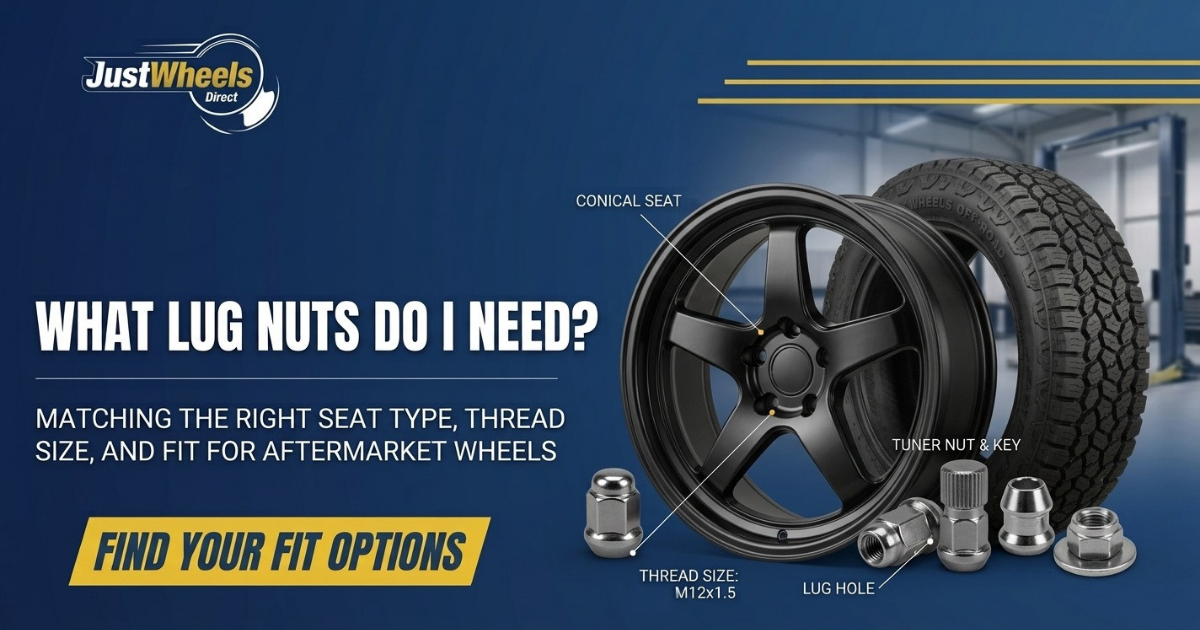
Most aftermarket wheels need lug nuts with a 60-degree conical seat, also called acorn lug nuts. The thread size must also match your car’s wheel studs, and the nut must fit inside the lug hole. Factory lug nuts often have a different seat shape, so they may not work. To pick the right set, check three things: the seat type, the thread size, and the fit.
Table of Contents
ToggleQuick Answer
- Seat type: Most aftermarket wheels use a 60-degree conical (acorn) seat.
- Thread size: It must match your vehicle’s studs, like M12 x 1.5 or M14 x 1.5.
- Fit: The nut head must fit in the lug hole. Narrow holes may need tuner or spline nuts.
Why Factory Lug Nuts Often Do Not Work
You just bought new wheels. They look great. Then you find out the old lug nuts do not fit right. This happens a lot.
Here is why. Your wheel does not sit on the hub by magic. The lug nuts pull it tight. The part of the nut that touches the wheel is called the seat. The lug hole in the wheel has a matching shape. If the nut and the hole do not match, the wheel does not sit flat. It can loosen over time. It can also shake or damage the wheel.
Factory wheels and aftermarket wheels are often made in different ways. So a factory nut may have a round seat or a flat seat, while your new wheel needs a cone. That is why new wheels usually mean new lug nuts.
If you are still choosing wheels, our wheels page has thousands of options. Plan for the lug nuts at the same time so you are not stuck on install day.
The Three Lug Nut Seat Types
Seat type is the most important check. There are three common types. Here is a simple table.
Seat type | What it looks like | Where you often see it | Works on aftermarket wheels? |
Conical (acorn) | A straight, angled cone, usually 60 degrees | Most aftermarket wheels | Yes, this is the most common |
Ball (radius) | A round, curved bowl shape | Many European factory wheels | Only if the wheel has ball seats |
Mag (flat) | A flat base with a washer and a long shank | Some factory wheels | Only if the wheel is made for it |
Some people say “acorn” and some say “conical.” They mean the same thing. A 60-degree cone is the standard for most custom wheels. A few racing wheels use a 45-degree cone, but that is rare on the street.
How to Check Your Seat Type
Look at the lug hole on your wheel. It tells you what you need.
- A straight, slanted wall means conical.
- A round, bowl-shaped curve means ball seat.
- A flat ring around the hole means mag or flat seat.
Ball and conical nut heads can look very close. So look at the hole, not just the nut. If you are not sure, ask the wheel maker or call our team. We can help you match the right nut to your wheels.
Check 2: Thread Size
The seat is one match. The thread is the other. The thread has to fit the studs on your vehicle.
A thread size like M12 x 1.5 has two parts. The first number is how wide the stud is, in millimeters. The second number is the distance between threads. If you get this wrong, the nut will not screw on, or worse, it will cross-thread and ruin the stud.
Here are some common sizes. Sizes can change by year and model, so always check your owner’s manual.
Vehicle | Common thread size |
Many Honda models | M12 x 1.5 |
Many Toyota models | M12 x 1.5 |
Many Nissan models | M12 x 1.25 |
Many Subaru models | M12 x 1.25 |
Ford F-150 (2015 and newer) | M14 x 1.5 |
Chevy Silverado 1500 | M14 x 1.5 |
The thread size does not come from the wheel. It comes from your vehicle. That means two people with the same wheels can need different lug nuts.
Do not mix up thread size with bolt pattern. The bolt pattern tells you how many lugs there are and how far apart they sit. Our wheel fitment guide explains bolt pattern, offset, and backspacing in plain words.
Check 3: Does the Nut Fit the Lug Hole?
Here is a check people forget. Some aftermarket wheels have small, narrow lug holes. A big hex nut may not fit inside. Even if the seat and the thread are right, the nut can be too wide for the hole.
Also think about your tools. A large hex nut needs a large socket. A slim wheel may not have room for it. In that case, you may need a tuner nut or a spline nut.
- Hex nuts use a normal socket. Common sizes are 17, 19, and 21 mm.
- Tuner nuts are smaller and use a special key.
- Spline drive nuts have grooves on the outside and use a special tool.
Tuner and spline nuts still have a seat. Most have a conical seat. So clearance and seat type are two separate checks.
Common Lug Nut Styles
Once you know the seat and the thread, you can pick a style.
Closed-end (acorn) lug nuts. These have a cap over the end. They cover the stud and keep it clean. Many drivers like the look.
Open-end lug nuts. These have no cap. They are short. They are good when the stud is long or when a cap will not fit.
Extended thread (ET) lug nuts. These have a conical seat and a longer shank. They give more thread grip. They help on older cars with short studs.
Tuner lug nuts. These are small and neat. They fit narrow holes. They need a special key.
Lug bolts. Some cars, like many European models, use bolts instead of nuts. Bolts also have seat types, so match them the same way.
Lug Nuts and Wheel Spacers
Wheel spacers move your wheel outward. That can change how much thread the nut can grab. Some spacers come with their own studs or nuts. Others need longer studs.
If you plan to add spacers, read our wheel spacers guide first. It covers safety, pros, and cons. Then pick lug nuts that give your studs enough thread grip.
Lug Nuts and Wheel Locks
Wheel locks protect your new wheels from theft. A lock takes the place of one lug nut on each wheel. So the lock needs the same seat and thread as the rest of your set.
Our wheel locks guide explains how they work and how to choose one. When you buy locks, check that the seat type matches your wheels.
How Many Lug Nuts Do You Need?
Count the lugs on one wheel. Then multiply by four, for the four wheels.
Lugs per wheel | Nuts for four wheels |
4 lugs | 16 |
5 lugs | 20 |
6 lugs | 24 |
8 lugs | 32 |
If you are adding locks, one nut on each wheel becomes a lock. So you will need one less regular nut per wheel. Many people also buy a few extras in case one gets lost or damaged. If you tow a trailer, check the lug type on the trailer too. Our trailer wheel buying guide can help.
How to Tighten Lug Nuts the Right Way
Good lug nuts still need good tightening. Follow these steps.
- Start by hand. Thread each nut by hand so it does not cross-thread.
- Snug them in a star pattern. Go across the wheel, not around in a circle. This pulls the wheel on evenly.
- Use a torque wrench. Tighten to the number from your owner’s manual or your wheel maker. Do not guess. Many cars fall in the range of about 76 to 100 ft-lb, but some trucks need more.
- Do it again in the star pattern. Go around one more time to check each nut.
- Check again after a short drive. Many wheel makers suggest checking the torque after about 50 to 100 miles.
Do not use an impact wrench for the final tightening. It can over-tighten and stretch the studs.
Pick the Right Finish
Lug nuts come in many finishes. Chrome, black, and polished are common. Pick one that goes with your wheels. Our guide to wheel finishes can help you match the look. If you choose chrome, our tips on how to clean chrome wheels will keep the nuts shining too.
Looks matter, but fit comes first. Never pick a nut only for its color. Match the seat and the thread before anything else.
Mistakes to Avoid
These slip-ups cause most lug nut trouble.
- Using factory nuts without checking the seat. A round-seat nut on a cone hole does not clamp right.
- Guessing the thread size. Look it up. Do not assume.
- Skipping the fit check. A nut that is too wide will not go into a narrow hole.
- Over-tightening with an impact wrench. Use a torque wrench.
- Forgetting the locks. Make sure locks match the seat and thread.
- Never re-checking the torque. Do a check after your first drive.
- Ordering the wrong count. Count your lugs first.
Frequently Asked Questions
Do aftermarket wheels need different lug nuts?
Often, yes. Most aftermarket wheels use a 60-degree conical seat. Many factory wheels use a ball or flat seat. If the seats do not match, you need new lug nuts.
Can I use factory lug nuts on aftermarket wheels?
Only if the seat type matches. In many cases it does not. If your factory nuts have a ball or flat seat, they will not clamp a conical wheel the right way.
Are acorn and conical lug nuts the same?
Yes. Acorn is the casual name. Conical is the technical name. Both mean a lug nut with a 60-degree tapered seat.
What are tuner lug nuts?
Tuner lug nuts are small lug nuts made to fit narrow lug holes. They use a special key to install and remove. Most have a conical seat.
Do I need new lug nuts with wheel spacers?
You might. Spacers change how much thread the nut can grab. Some need longer studs or special nuts. Follow the spacer maker’s advice.
What size wrench fits my lug nuts?
It depends on the nut. Common hex sizes are 17, 19, and 21 mm. Tuner and spline nuts use their own key.
What happens if I use the wrong lug nuts?
The wheel may not sit flat. It can shake, loosen, or damage the wheel and the studs. In the worst case, a wheel can come off. Always match the seat and the thread.
Get the Right Hardware With Your Wheels
New wheels should be a fun upgrade, not a headache. Match the seat, match the thread, and make sure the nut fits the hole. Do those three checks and you are set.
Ready to shop? Browse our custom wheels and our wheel accessories, or call our team at (855) 200-1655. We can help you match the right lug nuts to your order. Need help paying for the full setup? See our guide on how to finance wheels and tires.