




Do You Need TPMS Sensors for Aftermarket Wheels?

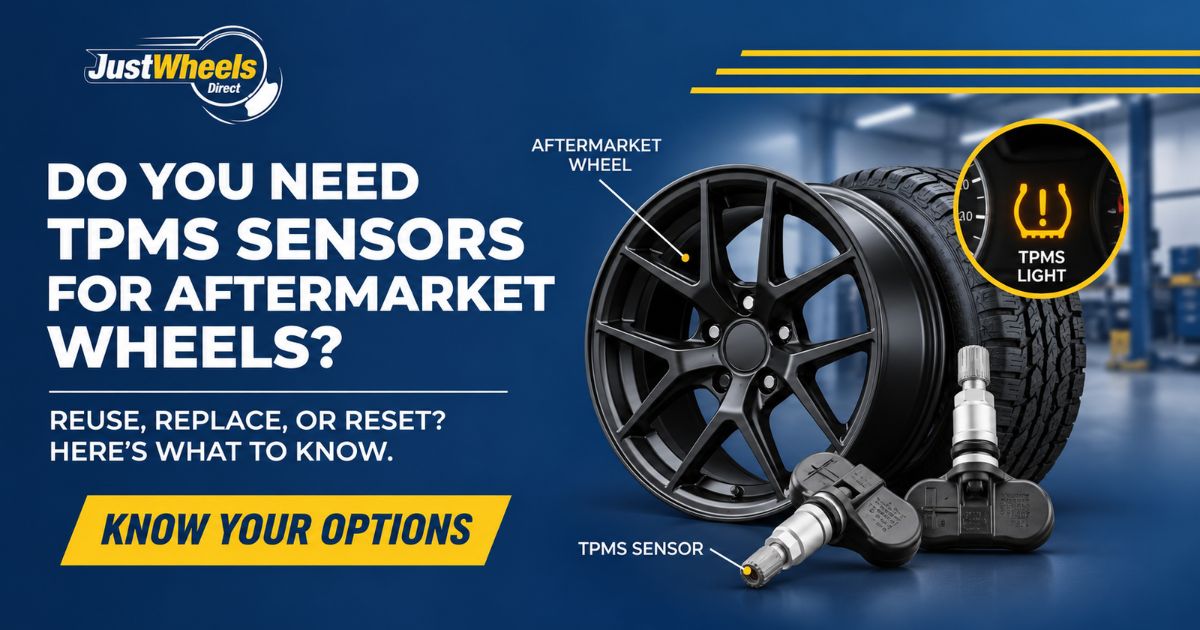
Yes, if your car has a direct tire pressure monitoring system (TPMS), every wheel needs a working sensor. In many cases you can move your factory sensors to the new wheels. If they do not fit, you will need new ones. Without sensors, your TPMS light will likely stay on, and you lose your early warning for a low tire. This guide shows you how to check your car in about a minute.
Table of Contents
ToggleThe Short Answer
Cars and light trucks sold in the U.S. after September 2007 must have a TPMS. Here is what that means when you buy new wheels:
- If your car has direct TPMS, you need a sensor in each wheel.
- If your car has indirect TPMS, you do not need sensors. You only need to reset the system.
- You can often reuse your old sensors if they fit the new wheels and are in good shape.
- New or moved sensors must be set up so your car can read them.
What Does TPMS Do?
TPMS watches the air in your tires. When a tire gets too low, a warning light shows on your dash. The rule is that the light must come on when a tire is about 25 percent below the pressure your car maker suggests. A tire that should hold 32 psi would trigger the light near 24 psi.
Low tires are bad news. They wear out faster, they grip less, and they can fail on the road. A TPMS light gives you time to fix the problem before it gets worse.
Your new wheels do not change this rule. But the sensors live inside your wheels, so when you swap wheels, the sensors must come along or be replaced.
Direct vs. Indirect TPMS
There are two kinds of TPMS. Your car uses one of them.
Type | How it works | Sensor in each wheel? | What you need for new wheels |
Direct TPMS | A small sensor by the valve stem reads the air pressure | Yes | Move your sensors or buy new ones, then set them up |
Indirect TPMS | The ABS system compares how fast each wheel spins. A low tire spins a little faster | No | A system reset after the tire change |
How do you know which one you have? Start with your owner’s manual. Many cars with direct TPMS also show the pressure of each tire on the dash screen. If you are still not sure, tell our team your year, make, and model. We can help you figure it out.
If you change your tire size with indirect TPMS, the reset matters even more. Our guide on upsizing custom wheels explains what changes when your wheels and tires get bigger.
Can You Reuse Your Factory Sensors?
Often, yes. Before you move them, check these four things.
- Does the sensor fit the new wheel? The sensor sits on the valve stem. The valve hole in the new wheel must match the stem style and angle. Most aftermarket wheels work with factory sensors. A few do not.
- Is the sensor healthy? Sensors run on small batteries that do not last forever. Many last about 5 to 10 years, but it depends on the sensor and how much you drive. If your sensors are old, replacing them while the tires are off the wheels can save you a second trip to the shop.
- Do you have fresh seals? When a sensor is moved, the shop should use new seals, a new nut, and a new valve core. Old rubber can leak. A slow leak will make your light come back on.
- Can the shop handle them with care? Tire machines can crack a sensor if the tech is not careful. Tell the installer you have TPMS before they start.
Clamp-In vs. Snap-In Sensors
The valve stem is where most fit problems begin. There are two main styles.
Style | What it looks like | How it holds | Where you often see it |
Clamp-in | A metal stem with a small nut at the base | The nut tightens against the wheel with a seal | Many Asian and European cars, and many aftermarket wheels |
Snap-in | A rubber stem that looks like a normal valve | The stem is pulled through the hole until it snaps in | Many domestic cars and trucks |
Most aftermarket wheels accept either style. Some wheels are trickier. Deep-drop wheels, wheels with unusual barrel shapes, and some forged designs may not give the sensor room to sit right. Our guide to forged wheels vs. cast wheels explains how wheel construction can change small details like this. The same goes for the choices in our 1-piece vs. 2-piece vs. 3-piece wheels guide.
The easy fix is to ask before you order. Call our team at (855) 200-1655 or use our contact page and tell us which wheels you like.
How to Check Your Setup in About a Minute
Follow these steps before you place your order.
- Look at your dash. Turn the key to the on position. A TPMS light (it looks like a flat tire with an exclamation point) should flash and then go off. This tells you your car has the feature.
- Read your owner’s manual. Look for the TPMS section. It will tell you if the system is direct or indirect.
- Look at your valve stems. A metal stem with a nut at the base is usually clamp-in. A rubber stem can still hold a snap-in sensor, so do not assume it is empty.
- Ask a tire shop to scan your sensors. A scan tool can read each sensor and show if the battery is weak.
- Match your wheels to your car. Use the vehicle selector on our wheels page so you only see wheels that fit your car.
Buying New TPMS Sensors
If your old sensors are worn out or do not fit, you will need new ones. You have three common choices.
- OEM sensors. These are made to match your car maker’s part. They are plug and play, but they may cost more.
- Aftermarket direct-fit sensors. These are built for your car’s make and model. Many shops use them.
- Programmable sensors. One sensor type can cover many cars. A shop sets it up with a special tool. These are popular for custom wheel setups.
Be careful with very cheap sensors from unknown brands. Some do not work with certain cars, and you could end up with a light that will not turn off. Make sure the sensor is made for your vehicle’s signal type.
Sensor prices change by vehicle and by brand. We do not want to guess, so please call our team for a current quote on the right sensors for your wheels.
How Your Car Learns the New Sensors
Every sensor has its own ID. Your car must learn which ID belongs to which tire. This step is called a relearn. Think of it like introducing new teammates to the coach.
There are three common ways it happens.
- Automatic learn. On some cars, the system learns the sensors after you drive for a short time.
- Stationary relearn. You follow a set of steps with the key, the dash, and a tool or the tire pressure, while the car is parked.
- Scan tool relearn. A shop plugs a tool into the car’s port. The tool wakes up each sensor and loads the IDs into the car.
Some makes always need a scan tool. Most tire shops have one, so this is usually a quick job. If you skip the relearn, the light can stay on even if the sensors are perfect.
Why Is My TPMS Light On After Getting New Wheels?
This is a very common question. Use this table to find the likely cause.
Cause | What it means | What to do |
No sensors in the wheels | A direct system cannot see the tires | Add sensors |
Sensors not learned | The car does not know the new IDs | Do a relearn |
A tire is truly low | The light is doing its job | Fill to the pressure on your door sticker |
Dead sensor battery | The sensor cannot send a signal | Replace the sensor |
Sensor damaged during tire mounting | The sensor is broken | Replace it, and ask the shop to be careful next time |
Indirect system not reset | The car still uses the old tire sizes | Reset the system using your dash or menu |
Wrong sensor type | The sensor does not match your car | Install the right sensor |
One more tip. Fill your tires to the number on your driver’s door sticker. Do not use the number on the tire’s sidewall. That number is the tire’s maximum, not the best pressure for your car.
Tips for Install Day
A few small steps can save you a lot of trouble.
- Tell the installer you have TPMS. Do this before the tires come off.
- Ask for new seals. If your old sensors are being reused, they need fresh seals, nuts, and cores.
- Check your lug nuts. Most aftermarket wheels need a different seat type than factory wheels. Our guide on lug nuts for aftermarket wheels shows how to check yours.
- Think about wheel locks. Locks protect your new wheels from thieves. Read our wheel locks guide to see if they make sense for you.
- Check the fit. Make sure your offset and bolt pattern are right. Our wheel fitment guide and offset and backspace calculator can help.
- Get an alignment if you changed sizes. Learn why it matters in our post on wheel alignment.
Can You Skip TPMS?
It is not a good idea. Here is why.
First, your dash light will stay on. A light that is always on is easy to ignore. Then you may miss a real warning when a tire is leaking.
Second, you lose a safety tool. A tire can lose air slowly and you may not notice by sight.
Third, some states may check the TPMS light during inspections. Rules are different in each state, so check yours.
Please do not ask a shop to turn off or block the TPMS light. Fix the cause instead. It is cheaper and safer in the long run.
Get Wheels and Sensors in One Order
The easiest way to avoid TPMS surprises is to plan for them while you shop. Pick your wheels first and then check the small parts: sensors, lug nuts, hub rings, and locks. Our wheel accessories page is a good place to start. Ask our team what is available for your car.
You can also read our post on buying a wheel and tire package vs. buying separately. It shows how a package can cover more of these details at once.
If budget is on your mind, our guide to financing wheels and tires explains your payment options. And if you want to learn more about how we work, visit why shop with us.
Frequently Asked Questions
Do I need TPMS sensors for new rims?
If your car has direct TPMS, yes. Each wheel needs a working sensor. If your car has indirect TPMS, you do not need sensors, but the system needs a reset.
Can I reuse my old TPMS sensors on new wheels?
Often, yes. The sensor must fit the new wheel’s valve hole, and it should be in good shape. Use new seals, a new nut, and a new valve core when you move it.
Will aftermarket wheels trigger the TPMS light?
They can if the sensors are missing, not learned, or damaged. The wheels themselves do not cause the light. A missing or unset sensor does.
Do new TPMS sensors need to be programmed?
Many do. Your car must learn the ID of each sensor. Some cars learn on their own after a short drive. Others need a scan tool or a set of steps while parked.
What is the difference between clamp-in and snap-in sensors?
A clamp-in sensor has a metal stem that is held by a nut. A snap-in sensor has a rubber stem that is pulled into the wheel. Both work. The right one depends on your car and your wheel.
Do I need TPMS sensors for a second set of winter wheels?
If your car has direct TPMS, yes. A second set needs its own sensors, or you must move one set of sensors each time you switch. Many drivers pick a second set of sensors to keep things simple.
Can a shop turn off my TPMS light?
A good shop will not. The right fix is to repair the sensor, set up the new sensors, or reset the system.
Need Help Matching Sensors to Your Wheels?
New wheels should be exciting, not stressful. Tell us your year, make, and model. We will help you check the fit, the valve stems, and the extra parts that go with your order. Browse our custom wheels or call our team at (855) 200-1655.