




1-Piece vs 2-Piece vs 3-Piece Wheels: Which One Is Right for You?

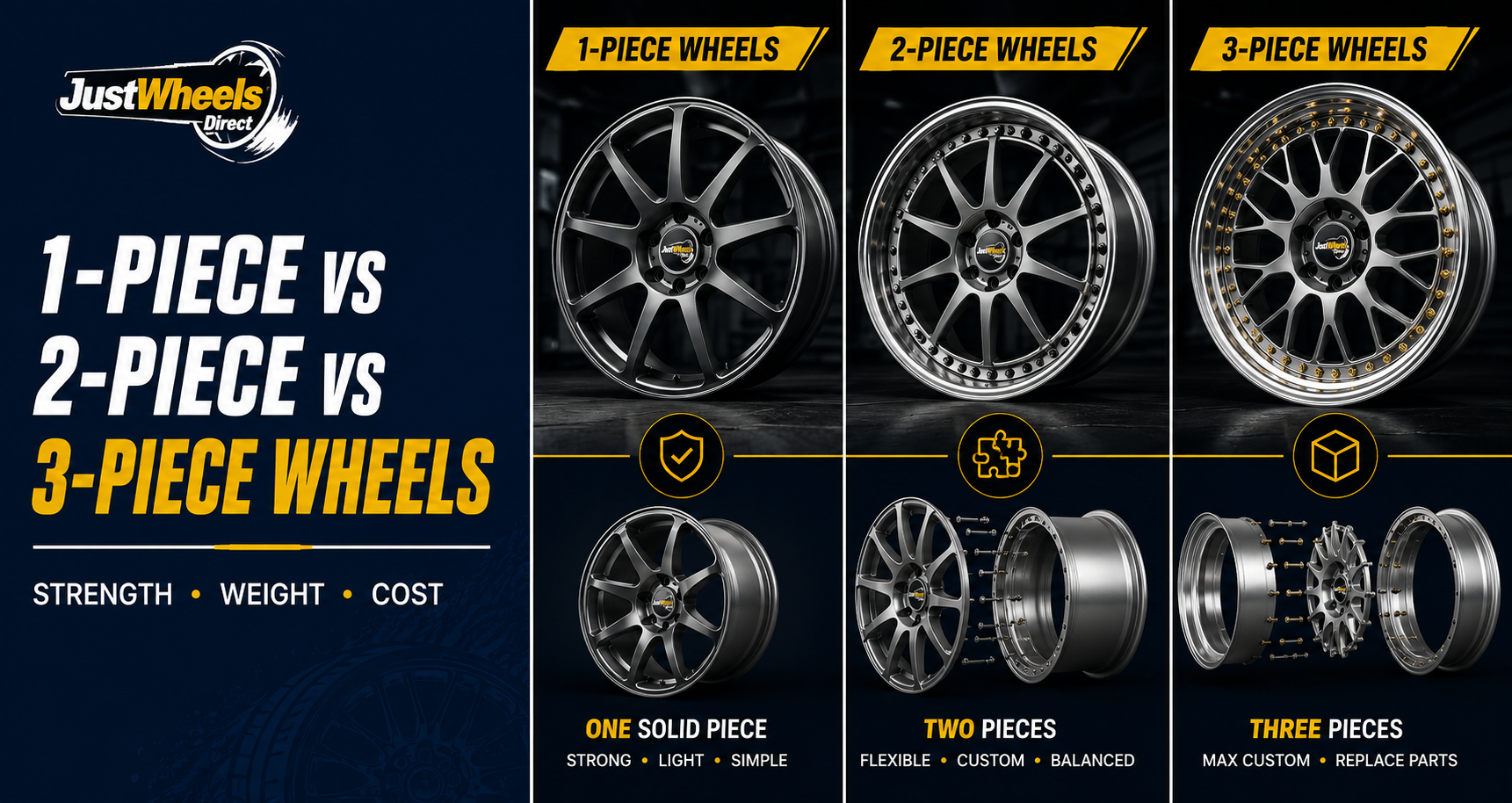
If you have been shopping for new wheels, you have probably seen the terms 1-piece, 2-piece, and 3-piece and wondered what they even mean. Here is the short answer. These terms describe how a wheel is built, not what it is made of. A 1-piece wheel is made from one solid piece of metal. A 2-piece wheel has a center and a barrel that are joined together. A 3-piece wheel has three separate parts that are bolted together. Each type has its own strengths, and the right one for you depends on how you drive, what look you want, and how much you want to spend.
Let’s break down each type in plain words, so you can pick the wheel that actually fits your life, not just your car.
Table of Contents
ToggleWhat Is a 1-Piece Wheel?
A 1-piece wheel is made from a single block of metal. There are no bolts, no seams, and no separate parts. The center and the outer rim are shaped as one solid piece, usually through casting or forging.
Why people choose 1-piece wheels:
- They are the strongest option because there are no weak points where parts connect.
- They are usually the lightest wheels you can buy.
- They need almost no upkeep. There are no bolts to check or seals to worry about.
- They tend to cost less than 2-piece or 3-piece wheels.
The trade-off: if a 1-piece wheel gets badly damaged, you usually cannot repair just one part. You have to replace the whole wheel. They also offer less room for custom sizing, since the shape is fixed once it is made.
This makes 1-piece wheels a smart pick for daily drivers, work trucks, and anyone who wants a strong, low-maintenance wheel without a high price tag. If this sounds like what you need, our American Racing Forged and Fuel Mono collections are both built this way and worth a look.
What Is a 2-Piece Wheel?
A 2-piece wheel has two main parts, a center face and an outer barrel, that are welded or bolted together. This gives wheel makers more freedom to mix and match. The same center design can be paired with different barrel widths to fit different cars.
Why people choose 2-piece wheels:
- More fitment options than a 1-piece wheel, since the barrel can be swapped for different widths.
- If the barrel gets curbed or bent, it can sometimes be replaced without buying a whole new wheel.
- A good middle ground between strength and style flexibility.
The trade-off: 2-piece wheels usually weigh a bit more than 1-piece wheels because of the extra hardware. They also cost more, and if the wheel is bolted rather than welded, you need to check the bolts now and then to make sure everything stays tight.
If you want a custom look without going all the way to extreme sizing, browse our Fuel 2pc or Foose 2pc collections for a solid middle-ground option.
What Is a 3-Piece Wheel?
A 3-piece wheel splits the design into three parts, a center section and two outer barrel halves, all bolted together with sealing hardware to keep air from leaking out. This modular design is the most customizable option on the market.
Why people choose 3-piece wheels:
- Maximum control over width, offset, and look. Shops can build a wheel to match an exact fitment.
- If one part gets damaged, in many cases only that piece needs to be replaced.
- They are often used for show cars and builds where a very specific stance matters.
The trade-off: 3-piece wheels are the heaviest and most expensive option. They also need the most upkeep. The bolts should be checked often, and the seals need to stay in good shape to avoid air or brake dust leaking in. Because of this, most experts do not recommend 3-piece wheels for heavy daily driving, off-roading, or towing.
If that level of custom fit is what you are after, our US Mag and Niche collections both offer this style of build.
Side-by-Side Comparison
Feature | 1-Piece | 2-Piece | 3-Piece |
Strength | Highest | High | Good, but weaker at joints |
Weight | Lightest | Medium | Heaviest |
Cost | Lowest | Medium | Highest |
Custom fitment | Limited | Some flexibility | Most flexible |
Repair options | Replace whole wheel | Sometimes replace barrel | Often replace one section |
Maintenance | Very low | Low to medium | Higher, check bolts and seals |
Best for | Daily driving, trucks, budget builds | Style plus some flexibility | Show cars, custom stance builds |
Which Wheel Type Is Right for You?
If you drive every day and want something reliable: go with a 1-piece wheel. It is strong, light, low cost, and needs almost no attention.
If you want a custom look but still drive your car often: a 2-piece wheel gives you more style options without the extra care that 3-piece wheels need.
If you are building a show car or want an exact custom stance: a 3-piece wheel gives you the most control, as long as you are willing to check it regularly.
If you tow, off-road, or drive on rough roads: stick with 1-piece wheels. Fewer parts means fewer things that can fail under stress. If you are shopping specifically for a trailer, check out our trailer wheels collection instead, since trailer wheels have their own sizing rules.
Does Piece Count Affect Weight the Same as Forged vs Cast?
Not exactly. Piece count is about how many parts make up the wheel. Forged versus cast is about how the metal itself is shaped. A wheel can be forged and still be built in 1, 2, or 3 pieces. If you want to understand how the metal forming process changes strength and weight, read our full breakdown on forged wheels vs cast wheels. And if weight savings are your main goal, our guide on lightweight wheel performance benefits covers exactly how much a lighter wheel can help your car.
Does Wheel Construction Affect Fitment?
Yes, especially with 2-piece and 3-piece wheels, since the barrel width can often be adjusted. But no matter which type you choose, you still need to match your offset and bolt pattern correctly. If you are not sure what those terms mean, our wheel fitment guide walks through it step by step, and our offset and backspace calculator can help you double check the numbers before you buy.
Common Questions About Wheel Construction
Are 1-piece wheels weaker than 2-piece or 3-piece wheels?
No. In most cases, 1-piece wheels are actually the strongest option, since there are no bolts or seams that can become a weak point.
Do 3-piece wheels leak air?
They can, if the seals are old or the bolts are not tight. This is why 3-piece wheels need regular checks. A 1-piece or 2-piece wheel does not have this issue since there is no separate barrel seal.
Which wheel type is the most expensive?
3-piece wheels are usually the most expensive because of the extra parts, labor, and hardware needed to build them.
Can I put 3-piece wheels on a truck I drive every day?
You can, but most experts do not recommend it. The extra maintenance and higher chance of a bolt or seal issue make 3-piece wheels better suited for show cars or occasional driving.
Is a 2-piece wheel a good middle ground?
Yes. A 2-piece wheel gives you more style options than a 1-piece wheel, without needing as much upkeep as a 3-piece wheel.
Final Thoughts
There is no single best wheel type. The right choice depends on how you use your vehicle. If you want strength and low cost, go 1-piece. If you want a bit more style flexibility, go 2-piece. If you want full custom control and do not mind extra care, go 3-piece.
Once you know which build fits your needs, browse our full wheel selection or check out our top brand picks in the brands directory to find the exact style you want.